Data Access Request: A Practical Guide for Founders
Learn what a data access request is, your GDPR and CCPA rights, timelines, and a step-by-step playbook for indie makers handling requests properly.
You're answering support messages between product fixes, launch reviews, and billing questions when a user writes: “Please send me everything you hold about me.” It looks like a simple export request. Then you notice the message also asks about old submissions, voting history, support conversations, analytics, and the sources of the data. A casual reply won't be enough.
A data access request is a product-operations event with a legal deadline. You need a reliable intake path, a way to verify the requester without creating unnecessary risk, a map of every system that may contain their data, and a secure delivery process. The legal language matters, but founders usually fail earlier, at the handoff between inbox, database, support tool, and export folder.
Table of Contents
- What a Data Access Request Really Is
- The Rights Behind the Request
- Timelines, Deadlines, and the Clock That Starts Immediately
- A Founder-Friendly Request Lifecycle Checklist
- How SourceX Can Help
- Identity Verification Without Collecting More Risk
- What a Good Response Actually Looks Like
- Automation, Record Keeping, and the Long-Term Loop
- Edge Cases Founders Ask About Later
What a Data Access Request Really Is
A common startup moment looks like this. A user writes to support, asks about deleting an account, then adds, “Before that, send me everything you have about me.” That second part changes the job. It is a data access request, and it needs to move out of the inbox and into a tracked workflow right away.
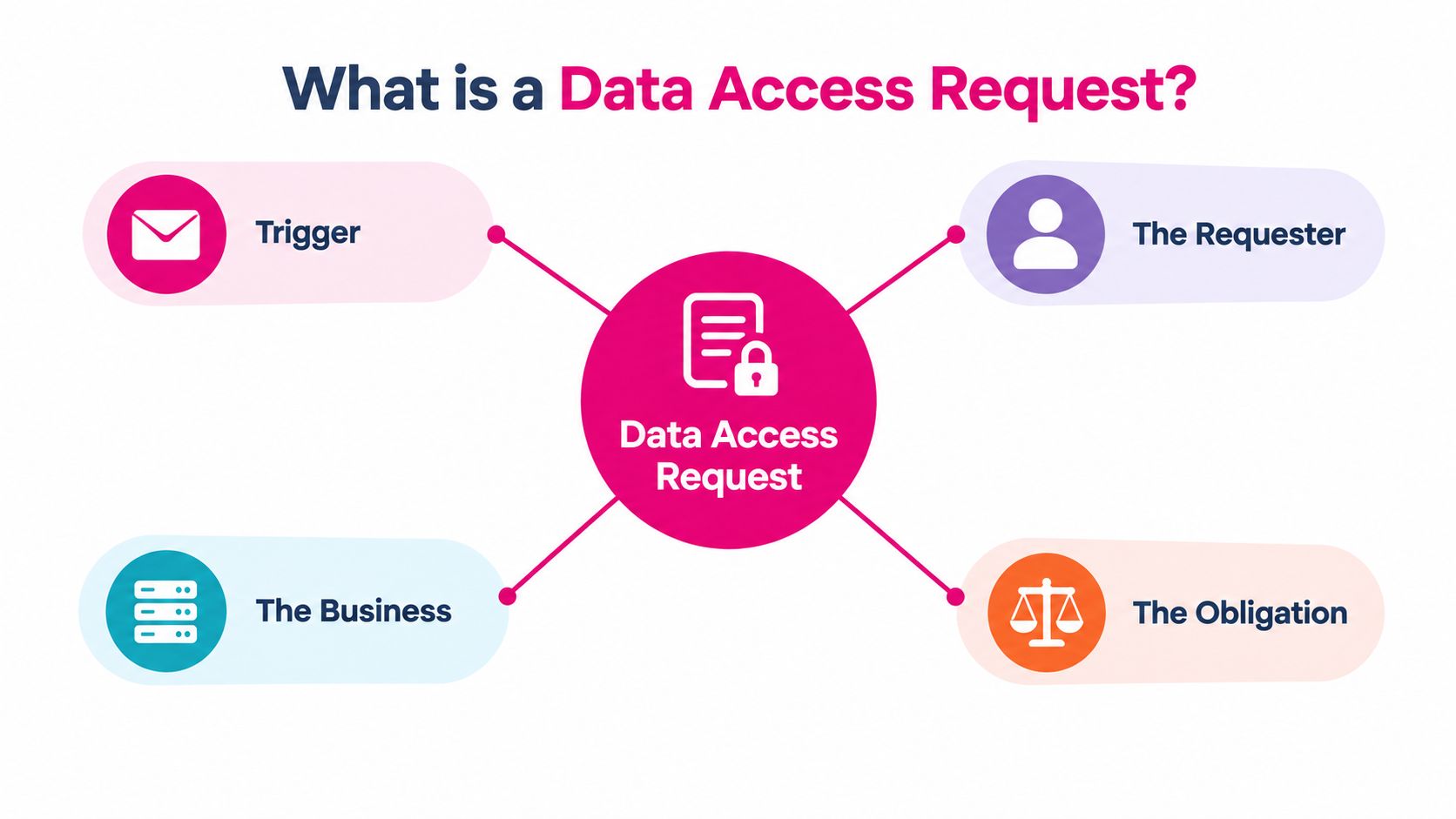
At a practical level, the person is asking three things. First, do you process personal data about me at all? Second, what is that data? Third, how are you using it? Under Article 15 of the GDPR, the answer usually includes the copy itself plus context such as the purposes of processing, categories of data, recipients, retention information, and the rights attached to that processing.
The legal rule matters, but the founder problem shows up earlier. A request like this works like an incident that touches support, product, and operations at the same time. If the email sits in one inbox while data lives across the app database, payment tooling, analytics, and support threads, the risk is not only delay. The bigger problem is losing track of what was searched, what was found, and what still needs review.
Interest in these rights was visible soon after the GDPR took effect. A SAS consumer survey found that nearly half of UK adults planned to use the new data rights. The survey was based on responses from 1,000 UK consumers and 850 consumers in the Republic of Ireland, and 15% said they intended to use those rights during the month the regulation came into force.
Article 15, in practical terms, gives a person the right to know whether you process their data, receive a copy, and understand how you use it.
That makes access different from other privacy rights that may appear in the same message. The words can look similar, but the work behind them is different.
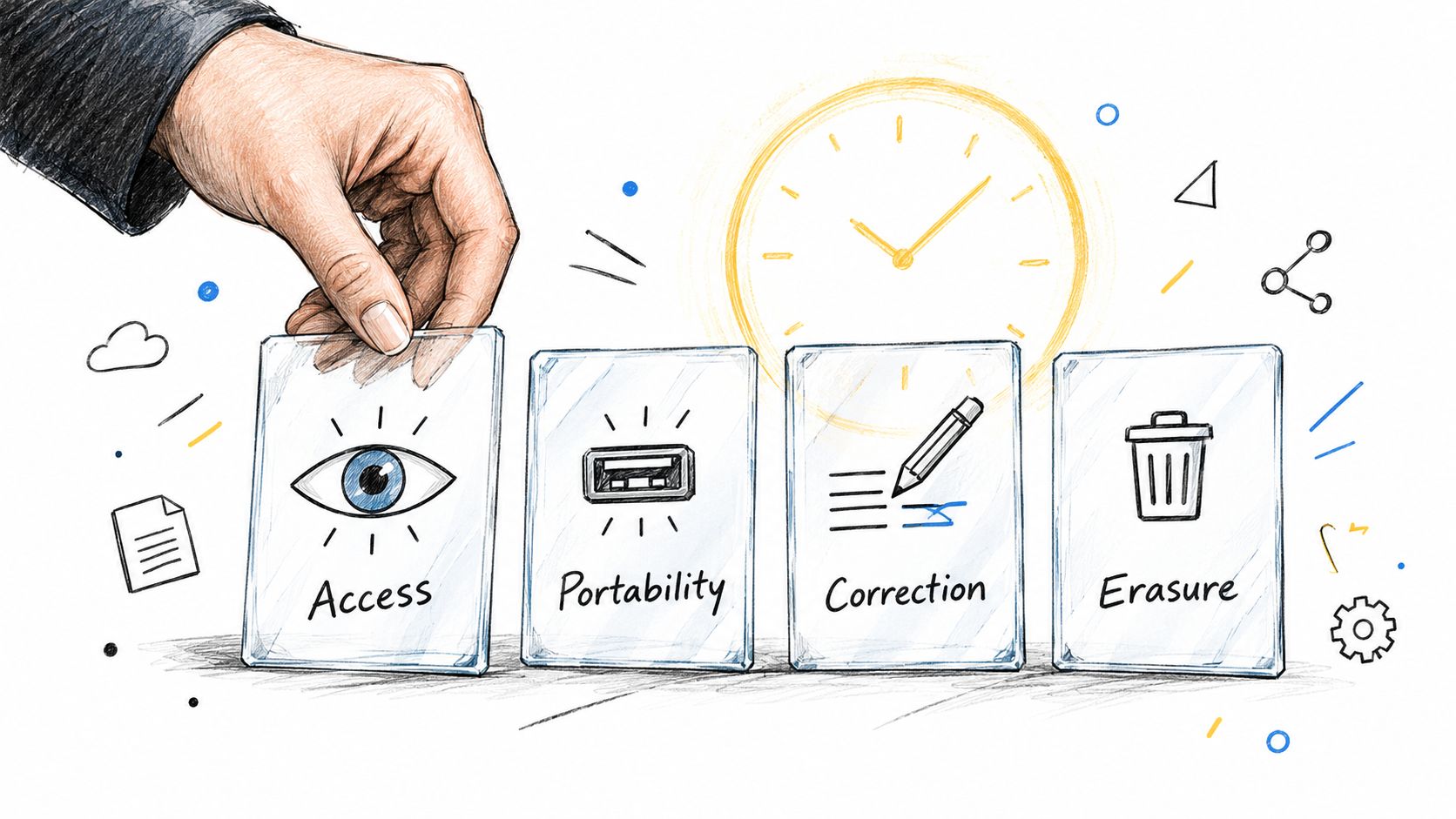
- Access asks what personal data you hold and how you process it.
- Rectification asks you to correct inaccurate or incomplete information.
- Erasure asks you to delete personal data where the legal conditions apply.
- Portability asks for certain data in a structured, commonly used, machine-readable format so it can be transferred where the right applies.
A user might ask for access first, review the response, and then ask for correction or deletion. If you treat every privacy message as the same request, the process gets messy fast.
Recognition is the first control
Channel matters less than intent. A valid request might arrive by email, contact form, in-app chat, or a message sent to a founder's personal account. If the person is clearly asking to access their data, the safe operational move is to log it, preserve the original wording, timestamp receipt, and assign one owner.
A privacy notice can explain preferred routes for requests, and IndieHunt's privacy information is a useful example of that kind of public guidance. It does not replace recognition across the rest of the business.
For an indie product, “everything you hold” can reach much further than the account table. It may include project submissions, votes, comments, payment records, support conversations, logs, or exported files. A neat CSV from the main database can look finished while still missing half the story.
The Rights Behind the Request
As covered above, access, correction, erasure and portability each trigger different work. The useful question here is operational: Can this record be linked to a person, directly or indirectly?
That test catches the data founders miss. A profile row is obvious. A support ticket tied to an email alias is still personal data. So is a payment reference that your team can match back to an account, or an analytics identifier that becomes identifiable once it is combined with other records. Personal data is less like a single folder and more like a trail across systems.
For an indie maker, that changes how you search. A launch platform may need to check the account database, project-submission tables, voting records, comments, the payment provider, the support tool, the analytics store, application logs and any document exports. If one of those systems can point back to the same person, it belongs in scope for review.
Build the response in two layers
A good response has two parts. First, the records themselves. Second, the context that makes those records understandable to the person who asked.
That second layer matters because a dump of tables or screenshots rarely answers the core question. Article 15 frames the supporting information people need to interpret what you send:
- Processing purposes: why you use each category of data, such as account management, payments, support, security or product analytics.
- Data categories: the kinds of information you found, including account records, activity records, communications or inferred information.
- Recipients: the recipients or categories of recipients that receive the data, such as hosting, payment, email, analytics or support providers.
- Retention: the planned retention period, or the criteria used to decide how long information stays.
- Rights and complaint route: information about correction, deletion, restriction, objection and the right to complain to a supervisory authority.
- Source and automated processing: where data came from if it was not collected directly, plus meaningful information about relevant profiling or automated decision-making.
Here is the product-ops version. If someone asks for everything connected with their launch account, your package might include the account record, submitted project material, votes, comments, payment-related records your business holds, support correspondence, relevant analytics identifiers and a short note on the systems searched. If a support thread also contains another person's details, you need a decision step for disclosure, redaction or withholding under the applicable rules. That is less a legal essay than a repeatable review task.
Know your role in the product
A controller decides why and how personal data is processed. A processor handles data for a controller under instructions.
In plain product terms, if you decide why to collect account data, how analytics are used or how a launch community runs, you are likely acting as a controller for those activities. Your vendors may help you search systems or export records. They do not take over the job of coordinating the response, checking scope or making the final call on what goes out.
Timelines, Deadlines, and the Clock That Starts Immediately
A data access request feels legal until it lands in a founder inbox at 4:47 p.m. Then it becomes an operations problem with a timer already running.
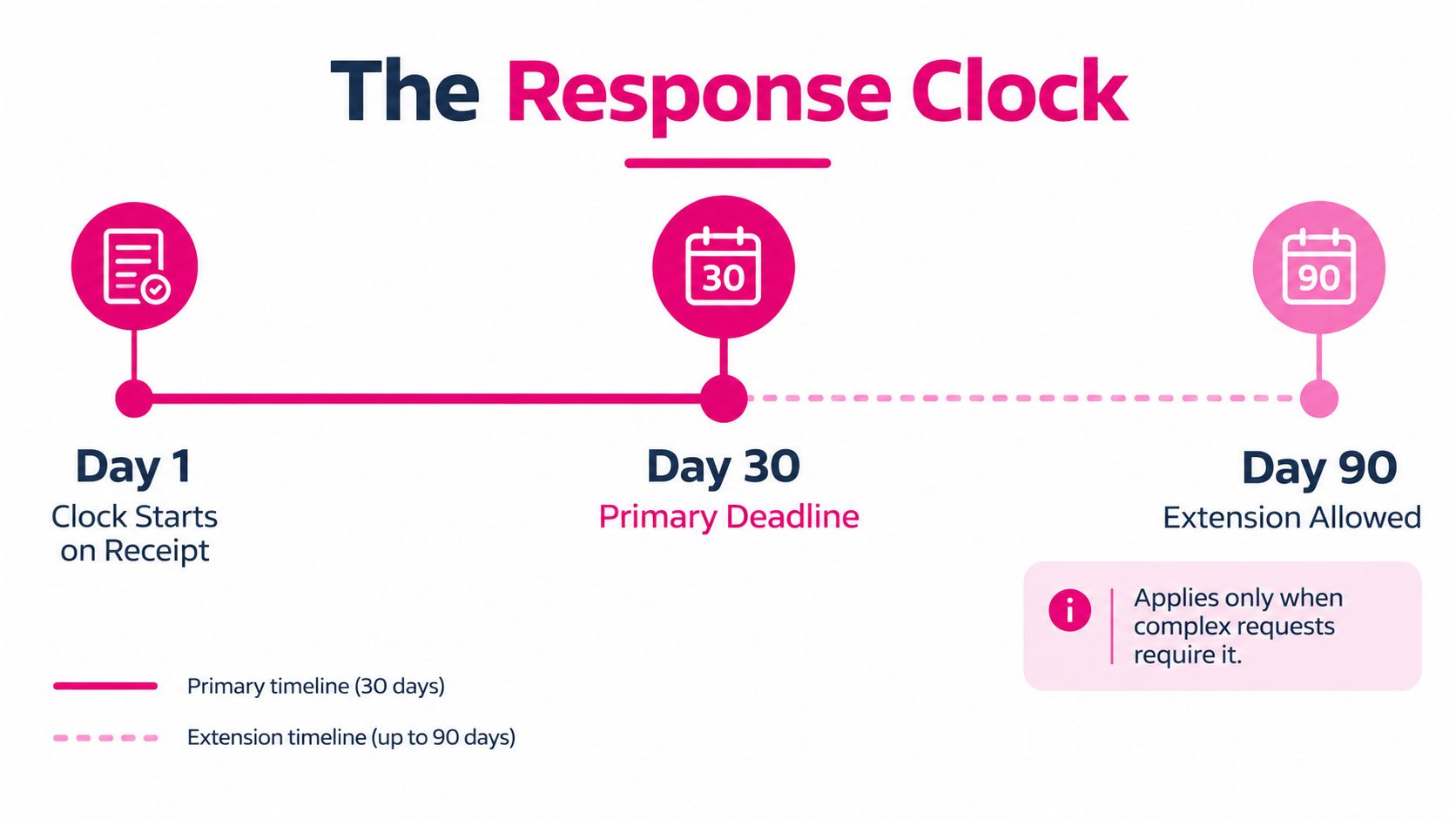
For a GDPR request, the response clock generally starts when you receive it. You need to answer without undue delay and, in principle, within one month. If the request is complex or you receive many at once, you may use a further two-month extension. The operational catch is simple. You must decide that within the first month, tell the requester, and explain why. As noted earlier, the EDPB guidance linked in the article explains the underlying rights model.
A public-sector UK report shows why this cannot stay as vague ownership across the team. During its reporting period, the organization completed 115 subject access requests, answering 107, or 93%, within the statutory one-month deadline. That was an improvement from 87% the previous year, yet 8 completed requests still missed the deadline (UK administrative dataset). “Mostly on time” still means specific people waited too long.
The practical model is a shipping deadline, not a legal memo. The month is your delivery window. If nobody owns intake, scoping, exports, review, and send-out, the request sits in support while the clock keeps moving.
Turn the month into checkpoints
Use the deadline as a small project plan that starts on day one:
- Receipt: Timestamp the request, keep the original wording, and calculate the due date.
- Early triage: Work out what the person is asking for, whether identity needs checking, and which systems are likely involved.
- Owner assignment: Alert the people responsible for your database, support tool, billing records, analytics, and logs.
- Assembly: Collect records, keep enough context to make them understandable, flag third-party data, and note any gaps.
- Quality review: Check coverage, redactions, explanations, and the delivery method.
- Delivery: Send the response before the deadline and keep evidence of what was sent.
If you serve more than one region, do not force every request through one template. A California request may run on a different timetable and under a different statutory framework. A jurisdiction field in your intake process helps you route the request to the right rule set before the team starts work.
A missed deadline can trigger a regulator complaint, a strained customer exchange, and trust problems that outlast the request itself. The useful response is operational. Escalate early, send a valid extension notice where the law allows it, and do not let “still searching” sit as an undocumented internal status.
This short walkthrough shows how the one-month clock and the extra extension period work in practice.
A Founder-Friendly Request Lifecycle Checklist
A useful runbook should be executable by someone who didn't build every system. Each step needs an owner, a reason, and a known failure mode. For a launch platform with submissions, voting, comments, payments, analytics, and support correspondence, the system map is as important as the response template.
Intake and triage
1. Capture the request. Record the receipt timestamp, channel, original wording, requester identifier, and a unique request ID. This preserves the starting point for the deadline and prevents an important message from disappearing inside support traffic. Avoid changing the requester's wording into a vague label such as “privacy issue.”
2. Confirm the scope. Separate access from correction, erasure, portability, objection, or opt-out requests. Ask for clarification when the scope is unclear, but don't use clarification as an automatic delay. A broad request can still be valid, and the person may choose to narrow it after you explain the available categories.
3. Verify proportionately. Use the account, original email address, or another low-friction signal where that establishes sufficient confidence. Escalate only when the identity or disclosure risk creates genuine doubt. Avoid making a passport scan the default for every user.
Search and assembly
4. Map data owners. List the systems that can hold relevant records: account database, project and voting tables, comments, payment processor, support tool, analytics store, logs, and backups where applicable. Assign each source to a named person or documented export method. The common mistake is searching the primary database and assuming vendor systems contain nothing important.
5. Gather records. Export structured data first, then inspect free-form content such as support tickets, comments, and internal notes. Preserve field names and enough context for the requester to understand what each record means. Do not discard unfamiliar fields just because they aren't visible in the user interface.
6. Review third-party information. Identify personal data belonging to other people, credentials, security secrets, and information covered by a relevant exemption. Redact only what you can justify, and record the reason for each material omission. A black rectangle without an explanation may look like concealment even when the redaction is legitimate.
Quality and delivery
7. Run a completeness check. Compare the final package against the original request and the system map. Check that dates, categories, inferred information, support communications, and machine-readable exports have been considered. The mistake to avoid is equating “the export generated successfully” with “the response is complete.”
8. Deliver securely. Use an encrypted delivery method, an expiring link, access logging, and a separate communication channel for any access credential. Don't attach a large unprotected file to a casual support reply when the package contains sensitive information.
9. Close the record. Log what was sent, when it was sent, who approved it, which systems were searched, what exemptions or redactions were applied, and how delivery occurred. Keep enough evidence to answer a later complaint without retaining identity documents or unnecessary copies indefinitely.
The workflow should feel boring after repetition. That's a sign that the process has moved from founder memory into product operations.
How SourceX Can Help
Some founders handle access requests inside their own product stack. Others are also considering whether operational datasets can be prepared for licensed use by AI labs or other data buyers. SourceX is designed for that separate but related data-governance problem: it organizes sourcing, rights validation, deidentification, contracts, delivery, and payment in a controlled workflow where the supplier approves each step.
That matters when records are spread across tools such as Zendesk, Salesforce, GitHub, Jira, SharePoint, or Google Workspace. SourceX can create a private inventory, document provenance and permissions, prepare dataset-specific deidentification, support pricing and terms, and assemble an evidence packet before release. The supplier retains control over authorization, scope, and permitted uses rather than treating an export as automatically licensable.
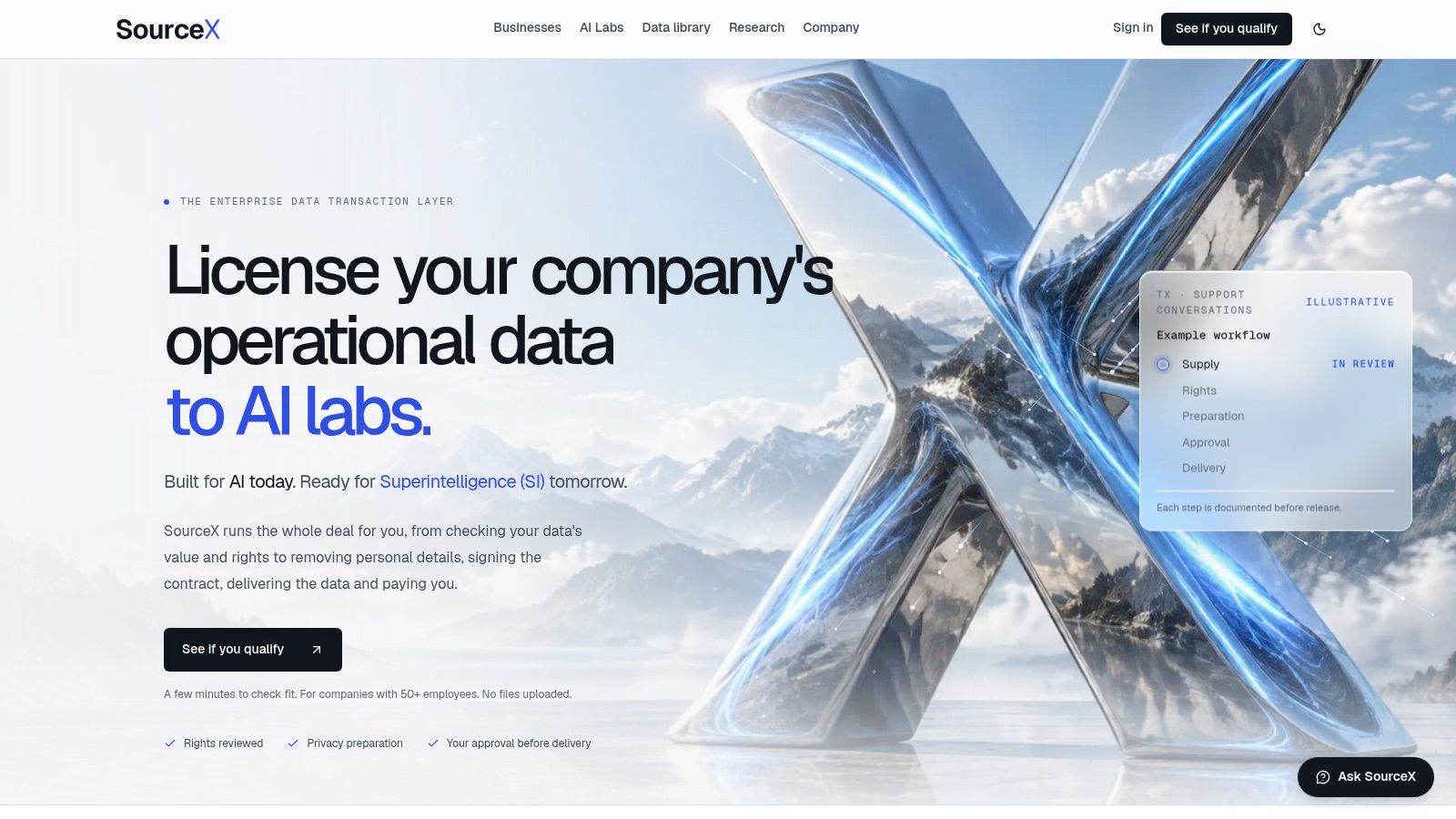
It's not a replacement for your access-request runbook. A data access response is about giving a person access to their own personal data and processing information. SourceX is more relevant when an organization has a potentially valuable operational dataset and needs rights-cleared preparation, buyer evaluation, contractual limits, and controlled delivery. If you're evaluating your own records for that purpose, you can submit a data access request to understand what information the service holds about you before making any separate licensing decision.
The important challenge is identity verification. Collecting more documents isn't automatically safer. A passport or utility bill creates another sensitive-data repository, increases handling obligations, and may exclude legitimate requesters who share devices, changed email addresses, or lack standard documents.
Identity Verification Without Collecting More Risk
A user signs in to the account that contains the requested data and writes from the email address associated with it. That's usually a lower-risk situation than a message from an unfamiliar address demanding a complete export. Verification should match the risk of disclosure, not the anxiety of the person processing the request.
| Situation | Proportionate response | Failure to avoid |
|---|---|---|
| Authenticated account holder using the account email | Confirm the account context and proceed, unless other signals create doubt. | Asking for government ID by default. |
| New or unusual email address | Use a step-up check based on information already held, and document why it was needed. | Treating an unfamiliar address as proof of fraud. |
| Authorized representative | Verify the person's identity and the authorization connecting them to the requester. | Sending the data to an agent without checking authority. |
| Sensitive records, minors, or unusual disclosure risk | Apply stronger, targeted controls and consider secure delivery safeguards. | Collecting a broad identity dossier unrelated to the risk. |
The response clock generally runs from receipt. If identity is uncertain, you can request information needed to establish that the person is the data subject or an authorized representative. That isn't an unlimited pause. You should ask promptly, explain what is needed, offer a less intrusive alternative where possible, and continue planning the search rather than placing the entire request in an invisible holding state.
Proportionality rule: Use all reasonable measures, but request no more information than you need to prevent an unauthorized disclosure.
A practical verification ladder starts with an authenticated account or the original contact route. If that isn't enough, use a targeted step-up check, such as confirming account details already known to the business. For a representative, record the authorization and limit disclosure to the authorized scope. For a minor, deceased person, or person using a guardian, apply the relevant jurisdictional rules instead of inventing a universal document requirement.
You can also reduce exposure by deleting identity evidence after the verification purpose ends, restricting access to it, and recording the verification decision without retaining unnecessary document images. Guidance from Ireland's Data Protection Commission emphasizes reasonable measures, data minimization, and avoiding excessive verification (DPC controller guide). For a product team, the test is simple: could you explain why this evidence was necessary, why a less intrusive option wouldn't work, and how long you kept it?
If users regularly ask about verification, publish a clear route and a short explanation. A product such as CaptainVerify can be considered for identity workflows, but it still needs to be configured around proportionality, retention limits, and the specific disclosure risk.
What a Good Response Actually Looks Like
A technically valid export can still be a poor answer. The file may arrive quickly but omit support correspondence, inferred profiles, metadata, or explanations for missing fields. A requester needs enough structure to understand what was found, what was not available, and what they can do if the response doesn't answer the question.
Response Quality Matrix
| Criterion | Minimum legal | Good response | Best-in-class |
|---|---|---|---|
| Scope coverage | Provides the requested personal data that was located. | Lists the systems and categories searched. | Maps each requested category to records, systems, and any deliberate exclusions. |
| Completeness | Applies justified redactions or exemptions. | Explains material omissions and third-party redactions. | Provides a redaction log, retention explanation, and a route to challenge unclear omissions. |
| Intelligibility | Delivers data in a usable form. | Explains field names, codes, identifiers, and file relationships. | Includes a readable summary alongside structured files and examples of how to interpret logs. |
| Timeliness | Responds within the applicable period or communicates a valid extension. | Sends progress information when the search is complex. | Tracks milestones internally and delivers early enough for a meaningful quality review. |
| Appeal clarity | Explains refusal or partial refusal and applicable rights. | Names the relevant complaint route. | Gives a clear contact, issue summary, and regulator route without making the requester reconstruct the decision. |
The difference appears in the assembly choices
Suppose your analytics export contains an internal identifier but no explanation of how it connects to the account. Include the identifier's meaning and the processing purpose. If a retention rule caused older records to disappear, say that the records weren't available and explain the retention criteria rather than presenting an empty result as proof that no data ever existed.
If an email thread includes another customer's address, redact that address where necessary, but don't automatically withhold the entire thread. Review whether the requester's own information can be separated. Record the reasoning so another person can reproduce the decision.
A fast, heavily redacted export can satisfy the appearance of responsiveness while leaving the requester unable to understand their history. A stronger follow-up would identify the categories omitted, describe the systems searched, explain the redactions, and ask the requester to specify any category that still appears missing. If the response included only current account fields, the founder should search support, comments, activity records, and vendor-held data before insisting that the initial export was complete.
The useful maintenance loop is small: every response produces a better system map, a clearer export template, and a more accurate list of recurring redaction decisions. Over time, the founder stops treating each request as a mystery and starts treating it as a test of whether the product's data architecture remains understandable.
Automation, Record Keeping, and the Long-Term Loop
A data access request feels legal the first time it arrives. After the second or third one, it starts to look like product operations. A person sends a message, a clock starts, someone has to verify identity, several systems need to be searched, and the final response has to be explained and delivered safely. If those steps live only in one founder's head, the process breaks the moment the team gets busy.
Start by automating the parts that are mechanical and time-sensitive. An intake form or monitored inbox can create a ticket, preserve the receipt timestamp, assign a request ID, and calculate the deadline from the moment the request comes in. That alone reduces a common failure mode, where the team spends days discussing scope before anyone records that the clock was already running.
Choose automation by effort and risk
The safest early automation is the kind that prepares work for a person instead of making the decision for them. For a small team, that usually means templates, routing, and checks that run the same way every time.
- Deadline calculation: Generate the due date from the recorded receipt time and flag upcoming milestones.
- Verification prompts: Offer an account-authenticated route and a higher-assurance path for cases that need more proof, without pushing every requester into document review.
- System routing: Send database, support, payment, analytics, and content searches to named owners so nobody assumes someone else handled them.
- Redaction helpers: Detect common third-party fields, credentials, and secrets, then require a human review before anything is removed.
- Secure delivery: Create an expiring encrypted link and log access instead of sending an ordinary attachment.
A useful rule is simple. Automate collection, tracking, and assembly. Keep judgment with a person. A script can flag a likely third-party email address. It cannot reliably decide, on its own, whether disclosure is proper in context.
Keep a defensible record
Every request should leave behind a file that another teammate could understand without asking for the backstory. That record should include the requester identifier, request scope, receipt date, deadline, systems searched, data owners, verification outcome, exemptions or redactions, delivery method, and final approval. If the requester later challenges the response, this is the difference between "we think we handled it" and "here is exactly what we did."
Structured content makes that easier. Machine-readable exports and per-page Markdown are easier to query, review, and explain than data trapped in free-form screens. If you're comparing tools for this kind of workflow, a record-oriented workflow product like RecordFlow shows the sort of structure that can help. The actual requirement is still clear ownership, traceability, and a format your team can inspect without guesswork.
Then keep the loop small enough to survive contact with a real startup week.
At the start of a launch cycle or product iteration, test the intake route, confirm that the deadline calculator still works, check that system owners still have access, refresh redaction templates, and run a sample export through the same secure delivery path you use for real responses. Close the loop by reviewing one finished request for completeness. Did the ticket explain the identifiers in the export? Did it note systems that were searched but held nothing responsive? Could another person reproduce the redaction decisions from the record alone?
That maintenance habit does more than tidy paperwork. Each completed request sharpens your system map, improves your export template, and builds a reusable list of recurring redaction calls. Over time, a founder stops treating a data access request like an interruption from legal and starts using it as an operational test: can the product still explain, retrieve, and safely deliver the personal data it creates?
Edge Cases Founders Ask About Later
A founder often feels the hard part is over once the first request is answered. Then the next request comes from a different role, under a different law, or through a channel your workflow did not expect. That is where data access work starts to look less like a legal memo and more like product operations.
An employee asks, not a customer. The same intake discipline still helps, but the systems change. You may need to search HR tools, payroll records, device logs, performance notes, or internal chat systems, then separate personal data from material that also contains management planning, legal privilege, or other workers' information. Give one owner the job of coordinating that search so the response does not fragment across teams.
The person is in California and asks to know, delete, or stop the sale or sharing of data. Treat that as a routing problem first. Identify which right is being used, then send it through the matching workflow. A data access request and an opt-out request can arrive in the same message, but they do not always require the same checks, disclosures, or downstream actions.
The request comes through a support ticket, app store review, or social DM. Your policy may prefer a webform, but the clock usually does not wait for a cleaner channel. Log the request where it arrived, move it into your normal queue, and answer from a secure path once identity is checked.
One more edge case matters because startups change fast. If you acquired a product, migrated vendors, or shut down an old tool, say which systems were searched, which were retired, and what data is no longer available. A clear system-history note often resolves confusion before it turns into a complaint.
The operating rule stays the same: treat each unusual request as a routing and record-keeping problem first, then apply the legal rule that fits the route.

Launch on IndieHunt
Submit your product to get featured in the weekly launch and reach indie founders looking for new tools.
Submit your project